Forty Years of Heart Transplants at Jackson Memorial Hospital and Miami Transplant Institute
Four decades after South Florida’s first heart transplant, Miami Transplant Institute continues to advance lifesaving care and expand access to donor hearts.
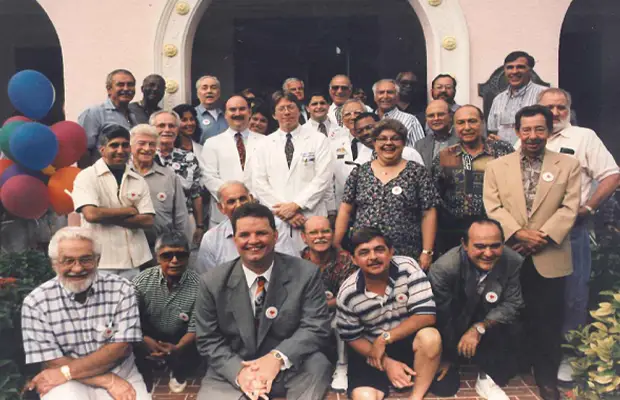
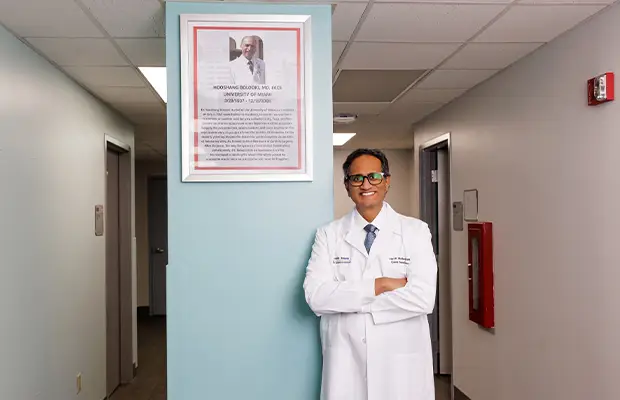
On Thanksgiving Day in 1986, a team led by cardiac surgeon Hooshang Bolooki, MD, performed South Florida’s first heart transplant at Jackson Memorial Hospital. The historic operation gave 26-year-old Mark Frye a second chance at life and marked the beginning of a heart transplant program that continues today at Miami Transplant Institute (MTI), an affiliation between Jackson Health System and UHealth – University of Miami Health System.
Dr. Bolooki’s team rehearsed the procedure countless times before a donor heart became available. Among them was transplant nurse Stana Novak, who went on to assist in many more heart transplants at Jackson.
“Dr. Bolooki was determined to launch the heart transplant program,” Novak said. “It’s what inspired us all to ensure our first-ever patient had the best shot at a fulfilling life.”
He went on to perform most of the program’s first 100 heart transplants. More than a decade after the first, he also performed Frye’s second heart transplant.
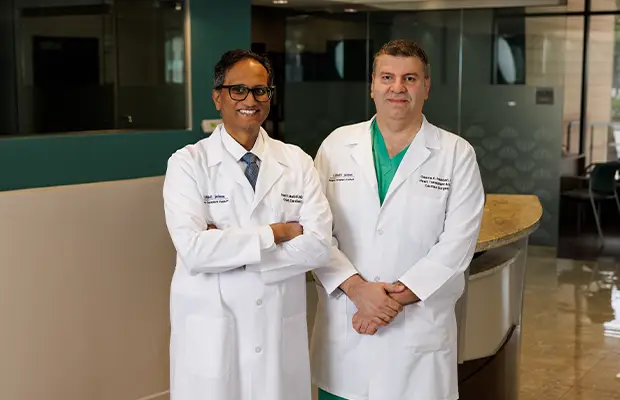
“We honor the pioneering team led by Dr. Bolooki, the patients who placed their trust in us, and the organ donors and families whose generosity makes this possible,” said Hari Mallidi, MD, chief of cardiac surgery at Jackson Health System, director of the Jackson Heart Institute, and program director of heart transplantation and mechanical circulatory support at MTI.
Today, the program is building on that foundation through advances in donor heart preservation, expanded access to donor hearts, and less invasive care after transplant.
Protecting every donated heart
The program now routinely uses controlled-temperature storage to preserve and transport donor hearts, helping protect them from temperature-related injury on its way to the recipient. The technology also gives the team more flexibility to accept hearts from farther away.
More donor hearts for more patients
MTI is also expanding access through donation after circulatory death, or DCD, which allows hearts to be donated after a person’s heart has stopped. Until recently, these hearts were rarely used for transplant.
Dr. Mallidi was a co-author of the landmark randomized trial, published in the New England Journal of Medicine in 2023, that helped establish the clinical evidence supporting DCD heart transplantation.
“Being part of that research gave me direct experience with an advance that is changing what is possible in heart transplantation,” Dr. Mallidi said. “I’ve brought that experience to MTI, working with our team to make DCD transplantation available to our patients. Expanding the donor pool creates more opportunities for people whose lives depend on receiving a heart.”
Additionally, the program uses carefully selected hearts from donors with hepatitis C, supported by effective antiviral treatment. Dr. Mallidi helped build the evidence as a co-author of DONATE HCV, a 2019 New England Journal of Medicine study that demonstrated the possibility of transplanting hearts and lungs from donors with hepatitis C into uninfected recipients using early antiviral therapy.
Less invasive care after transplant
Care after transplantation is changing, too. MTI is moving toward less invasive rejection monitoring with donor-derived cell-free DNA testing, which measures parts of DNA from the transplanted heart in the recipient’s blood. Used alongside other clinical tests, it can help detect possible injury to the new heart and reduce the need for heart biopsies in certain patients.
Forty years later, hundreds of lives changed
Since that first operation in 1986, the heart transplant program at Jackson Memorial and MTI has performed more than 820 heart transplants, giving patients and families a renewed hope for the future.
“I take immense pride in leading MTI’s heart transplant program as we celebrate 40 years since South Florida’s first heart transplant at Jackson Memorial Hospital,” Dr. Mallidi said. “Being part of this milestone has deepened my appreciation for the people who built these programs and my sense of responsibility to carry their work forward by bringing the next generation of advances to the patients and families who depend on us.”
Read more: Discover our 30th Anniversary story